In today’s lesson, we’re exploring the backtracking concept.
The backtracking concept features one of the tools that top players use – especially gospel pianists – and that’s why experts recommend that every serious pianist must learn, explore, and master it.
What distinguishes the top players from the amateur ones are the tools, tricks, and techniques they incorporate into their playing. The top players you know today have invested time, talent, and treasure into learning several techniques and I’ll be showing you one of those important techniques (backtracking) in this lesson.
If you invest the next 15 minutes or so in this blog, you’ll have the five levels of backtracking within your grasp.
A Quick Review On The Backtracking Concept
It’s practically proven by experts that the strongest chord progressions in tonal music descend in fifth intervals. For example, the strongest option of what the C major chord:
…progresses to is the F major chord:
…and this is because a fifth below C:
…is F:
This C-F chord progression in the key of F major:
…can be considered a 5-1 chord progression – from the fifth degree (aka – “dominant”) to the first degree (aka – “tonic”) and is the strongest diatonic progression in the key of F major:
Here’s the music clock:
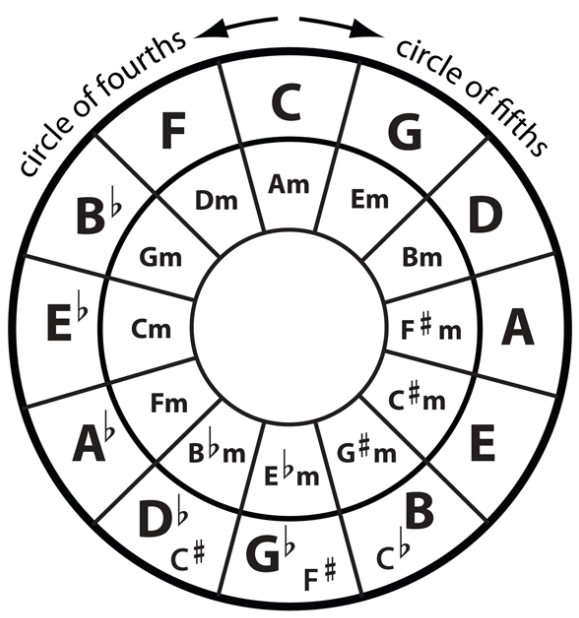
…which is a geometrical representation of the twelve musical notes:
…in fourth (counter-clockwise) and fifths (clockwise), hence, it’s called the circle of fourths or circle of fifths.
C is at the 12 o’clock position
G is at the 1 o’clock position
D is at the 2 o’clock position
…and so on, up to F at the 11 o’clock position.
Backtracking – Explained
The term backtracking literally means to retrace one’s steps and can be applied too in chord progressions. For example, you can backtrack the C major triad:
…by going counter-clockwise (or retracing your steps in the musical clock):
…from C (at the 12 o’clock position) to F (at the 11 o’clock position.)
To backtrack the C major triad you’ll have to play an F major triad (over C on the bass):
…before the C major triad:
“Check Out Another Example…”
The E major triad:
…can be backtracked by going counter-clockwise (or retracing your steps in the musical clock):
…from E (at the 4 o’clock position) to A (at the 3 o’clock position.)
To backtrack the E major triad you’ll have to play an A major triad (over E on the bass):
…before the E major triad:
Levels Of Backtracking
There are five levels of backtracking and we’ll be exploring them in this segment.
First Level Of Backtracking
In the first level of backtracking, we’re going down counter-clockwise by a step in the musical clock. For example, the C major triad:
…can be backtracked to the F major triad:
…at the first level of backtracking.
The D major triad:
…can be backtracked to the G major triad:
…at the first level of backtracking.
Second Level Of Backtracking
In the second level of backtracking, we’re basically going down by two steps in the musical clock. For example, a second level backtracking of the C major triad can be played thus:
Bb major triad (over C on the bass):
F major triad (over C on the bass):
C major triad (over C on the bass):
The reason for the introduction of the Bb major triad:
…is because in the musical clock:
…Bb is two steps from C in the counter-clockwise direction.
In the same vein, any major triad can undergo the second level of backtracking be going counter-clockwise by two steps in the musical clock. For example, at the second level of backtracking, the E major triad:
…would progress to the D major triad (over E on the bass):
A major triad (over E on the bass):
E major triad (over E on the bass):
Following the same procedure, any major triad can also undergo the second level of backtracking.
Third Level Of Backtracking
At the third level of backtracking, we’re going counter-clockwise in the music clock:
…by three steps. For example, three sectors before Eb:
…(at the 9 o’clock position) is Gb:
…(which is at the 6 o’clock position.)
Consequently, at the third level of backtracking, the Gb major triad is played (over Eb on the bass):
…before progressing to the Db major triad (played over Eb on the bass):
…before progressing to the Ab major triad (played over Eb on the bass):
…before it gets back to the Eb major triad (played over Eb on the bass):
Final Words
Backtracking a triad creates an anticipation for it, and there are five levels of backtracking and they can be applied either in songs or as chord progressions.
If you are interested in mastering the backtracking concept, then it is recommended that you go ahead and practice the various levels of backtracking that we’ve covered in this lesson and do your best to apply it on any given major triad on the keyboard.
Thank you for your time, and see you in another lesson.