This post will show you how to play diatonic seventh chords in any key using the “part-over-root” voicing technique.
Suggested reading: Part-Over-Root Voicing Technique.
In addition to the efforts we’ve made in the past to study major, minor, and dominant chord qualities using the part-over-root voicing technique, we’ll now be exploring these chords from a diatonic perspective.
The term diatonic simply means “progressing through the notes.”
Anything that is done by moving through or creating a relationship between the notes of a given major or minor scale is said to be diatonic.
If you can spare two minutes, I want to take you back like a slingshot for a quick, simple review of diatonic chords.
If you’re familiar with them already, then scroll down and meet me in the next segment.
Review of Diatonic Chords
The major scale has seven tones. Here are the seven tones of the C major scale:
C is first tone.
D is second tone.
E is third tone.
F is fourth tone.
G is fifth tone.
A is sixth tone.
B is seventh tone.
These seven notes are also known as the seven diatonic degrees and in chord formation, chords can be formed from every diatonic degree. Check out these triads…
Chord 1:
…C major triad.
Chord 2:
…D minor triad.
Chord 3:
…E minor triad.
Chord 4:
…F major triad.
Chord 5:
…G major triad.
Chord 6:
…A minor triad.
Chord 7:
…B diminished triad.
Before we proceed, here are the seventh chords too…
Chord 1:
…C major seventh.
Chord 2:
…D minor seventh.
Chord 3:
…E minor seventh.
Chord 4:
…F major seventh.
Chord 5:
…G dominant seventh.
Chord 6:
…A minor seventh.
Chord 7:
…B half-diminished seventh.
Diatonic Perspectives to Part-Over-Root Voicings
It’s not enough to know that the C major seventh chord:
…is basically an E minor triad played over C in the bass:
It is better for us to understand the diatonic relationship between the “part” and the “root.”
In the case of the C major seventh chord, we can ask the question, “what is the diatonic relationship between the part (E minor triad) and the root (C)?”
Let’s look at all diatonic seventh chords in the key of C major and the diatonic relationship between their parts and roots respectively.
Once understood in C, feel free to transpose them to other keys.
Chord 1 – C Major Seventh
The diatonic function of the C major seventh chord:
…in the key of C major is chord 1.
Notice the relationship between C (the root) and the E minor triad (the part). The root is the first tone of the C major scale while the part is chord 3.
Therefore, chord 1:
…can be formed by playing chord 3:
…over the first tone of the C major scale:
Here’s an example in the key of F…
Playing chord 3 in the key of F major (which is A minor):
…over the first tone of the F major scale would produce Amin/F:
…F major 7, which is chord 1 in the key of F major.
Chord 2 – D Minor Seventh
The D minor seventh chord:
…functions as chord 2 in the key of C major.
See the relationship? The root (D) is the second tone of the C major scale while the part (F major) is chord 4.
Therefore, chord 2:
…can be formed by playing chord 4:
…over the second tone of the C major scale:
Here’s an example in the key of F…
Playing chord 4 in the key of F major (which is Bb major):
…over the second tone of the F major scale would produce Bbmaj/G:
…G minor 7, which is chord 2 in the key of F major.
Chord 3 – E Minor Seventh
The E minor seventh chord:
…functions as chord 3 in the key of C major.
The relationship between E (the root) and the G major triad (the part) is that the root is the third tone of the C major scale while the part is chord 5.
Therefore, chord 3:
…can be formed by playing chord 5:
…over the third tone of the C major scale:
Here’s an example in the key of F…
Playing chord 5 in the key of F major (which is C major):
…over the third tone of the F major scale would produce Cmaj/A:
…A minor 7, which is chord 3 in the key of F major.
Chord 4 – F Major Seventh
The diatonic function of the F major seventh chord:
…in the key of C major is chord 4.
The relationship between F (the root) and the A minor triad (the part) is that the root is the fourth tone of the C major scale while the part is chord 6.
Therefore, chord 4:
…can be formed by playing chord 6:
…over the fourth tone of the C major scale:
Here’s an example in the key of F…
Playing chord 6 in the key of F major (which is D minor):
…over the fourth tone of the F major scale would produce Dmin/Bb:
…Bb major 7, which is chord 4 in the key of F major.
Chord 5 – G Dominant Seventh
The diatonic function of the G dominant seventh chord:
…in the key of C major is chord 5.
The relationship between G (the root) and the B diminished triad (the part) is that the root is the fifth tone of the C major scale while the part is chord 7.
Therefore, chord 5:
…can be formed by playing chord 7:
…over the fifth tone of the major scale:
Here’s an example in the key of F…
Playing chord 7 in the key of F major (which is E diminished):
…over the fifth tone of the F major scale would produce Edim/C:
…C dominant 7, which is chord 5 in the key of F major.
Chord 6 – A Minor Seventh
The A minor seventh chord:
…functions as chord 6 in the key of C major.
The relationship between A (the root) and the C major triad (the part) is that the root is the sixth tone of the C major scale while the part is chord 1.
Therefore, chord 6:
…can be formed by playing chord 1:
…over the sixth tone of the C major scale:
Here’s an example in the key of F…
Playing chord 1 in the key of F major (which is F major):
…over the sixth tone of the F major scale would produce Fmaj/D:
…D minor 7, which is chord 6 in the key of F major.
Chord 7 – B Half-Diminished Seventh
The diatonic function of the B half-diminished seventh chord:
…in the key of C major is chord 7.
The relationship between B (the root) and the D minor triad (the part) is that the root is the seventh tone of the C major scale while the part is chord 2.
Therefore, chord 7:
…can be formed by playing chord 2:
…over the seventh tone of the F major scale:
Here’s an example in the key of F…
Playing chord 2 in the key of F major (which is G minor):
…over the seventh tone of the F major scale would produce Gmin/E:
…E half-diminished 7, which is chord 7 in the key of F major.
Check out the table below:
|
Degree |
Part |
Root |
|
1st |
Chord 3 |
First tone |
|
2nd |
Chord 4 |
Second tone |
|
3rd |
Chord 5 |
Third tone |
|
4th |
Chord 6 |
Fourth tone |
|
5th |
Chord 7 |
Fifth tone |
|
6th |
Chord 1 |
Sixth tone |
|
7th |
Chord 2 |
Seventh tone |
From the table above…
Playing chord 3 over the first tone will produce the chord of the first degree.
Playing chord 4 over the second tone will produce the chord of the second degree.
Playing chord 5 over the third tone will produce the chord of the third degree.
Playing chord 6 over the fourth tone will produce the chord of the fourth degree.
Playing chord 7 over the fifth tone will produce the chord of the fifth degree.
Playing chord 1 over the sixth tone will produce the chord of the sixth degree.
Playing chord 2 over the seventh tone will produce the chord of the seventh degree.
This is how it works in every key.
Final Words
By now, I have no doubt that you have a newfound diatonic perspective of the part-over-root voicing concept.
This leaves you with one assignment that you must do without fail. This assignment is for anyone who’s seriously interested in incorporating seventh chords into their playing.
Practice these chords from key to key using the musical clock:
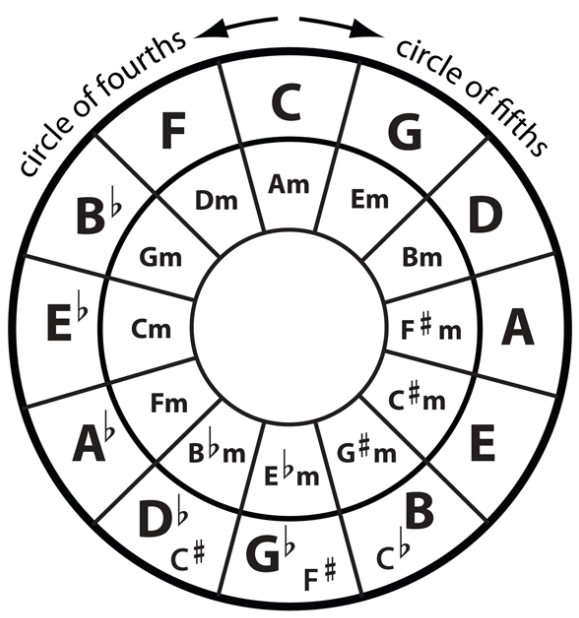
…as a guide. You’re at liberty to choose the order, whether clockwise:
C
G
D
A
E etc.
…or, our favorite, counter-clockwise:
C
F
Bb
Eb
Ab etc.
Until next time.
P.S.
Feel free to post your comments and questions in the comment box below.