As you’ve learned in past lessons, the octave can be divided into equal parts and melodic progressions are a product of the division of the octave into such equal parts.
On the first day of Christmas, we covered the totality of the octave and how melodic and harmonic materials can be found within its compass.
In today’s post, I’m going to take you deeper into octave studies by exploring its division into equal parts.
Review of the Octave
There are seven natural tones in music. These tones are represented using the first seven alphabets – A to G.
Octave is the eighth tone in series starting from any of the natural tones above. For example,
A to A:
D to D:
The eighth tone is considered important because it has the same letter name as the first tone. The octave (8th tone of) C is C, the octave of F is F etc.
Even though the octave is the eighth tone, it encompasses all the pitch classes in music – twelve of them.
The octave of C…
…contains all twelve pitch classes:
In this post, we’re going to represent the octave with twelve, as opposed to seeing it as the eighth tone and associating it with eight.
You may not be used to the consideration of the octave as twelve but for the sake of what we’re going to study here, let’s consider the octave as a totality of twelve pitch classes.
Melodic Progressions
The octave in its totality (of twelve pitch classes) can be divided into a certain number of parts.
This divisions will yield what we call melodic progressions. There are several melodic progressions in music, however, we’ll cover six common ones that are important in chord progressions and scale formation. These melodic progressions include:
• Semitone
• Wholetone
• Sesquitone
• Ditone
• Tritone
The two unfamiliar ones in the list include sesquitone and diatessaron. Semitone, wholetone, ditone and tritone are pretty common so you may have heard of them before. If you haven’t, then read on because I’ll be covering each of the melodic progressions above in today’s post.
Let’s get started with the very first – semitone progression.
Semitone Progression
The division of the octave into twelve equal parts will produce the semitone progression.
The octave in its totality contains twelve pitch classes. Therefore, the division of these twelve pitch classes into twelve parts can be mathematically given as:
12 pitch classes/12 equal parts = 1
Therefore, from one pitch class to an adjacent pitch class in any direction (ascending or descending) is a semitone progression. There are twelve semitone progressions in one octave:
C-C♯
[thrive_lead_lock id=’11374′]
C♯-D
D-D♯
D♯-E
E-F
F-F♯
F♯-G
G-G♯
G♯-A
A-A♯
A♯-B
B-C[/thrive_lead_lock]
This melodic progression is closely related to two intervals:
Augmented Unison
Minor second
(Read this post on Melodic Progressions vs Intervals).
*”Half step” is often used interchangeably with “semitone progression.”
Wholetone Progression
Division of the octave into six equal parts will produce the wholetone progression.
The octave in its totality contains twelve pitch classes. Therefore, the division of these twelve pitch classes into six equal parts can be mathematically given as:
12 pitch classes/6 equal parts = 2
Therefore, from one pitch class to two adjacent pitch classes in any direction (ascending or descending) will yield a wholetone progression. In one octave, there are six wholetone progressions:
C-D
[thrive_lead_lock id=’11374′]
D-E
E-F♯
F♯-G♯
G♯-A♯
A♯-C
[/thrive_lead_lock]
This melodic progression is related to two known intervals:
Major second
Diminished third
Sesquitone Progression
Sesquitone progression is a product of the division of the octave into four equal parts.
Considering the octave as a totality of twelve pitch classes, if we go ahead and divide it into three equal parts, we’ll have:
12 pitch classes/4 equal parts = 3
Therefore, from one pitch class to three adjacent pitch classes in any direction (ascending or descending) will yield a sesquitone progression. In every octave, there are four sesquitone progressions:
C-D♯
[thrive_lead_lock id=’11374′]
D♯-F♯
F♯-A
A-C
[/thrive_lead_lock]
The Italian word sesqui means half. Therefore sesquitone literally means an addition of a half step to a wholetone (which is sometimes called a tone) progression. If you do the math:
Wholetone (2) + Half (1) = Sesquitone (3)
Elements of the diminished (seventh) chord and scales are related to this very cycle. If you are familiar with diminished seventh chords in all the keys, you won’t have any difficulty whatsoever in understanding this melodic progression. For example, D diminished seventh chord:
…is closely related to the sesquitone progression. If we go ahead and calculate the interval between chord tones, we can see that:
D to F:
F to A♭:
A♭ to C♭:
…and C♭ to D:
…are all sesquitone progressions (in between the notes in each case are three adjacent pitch classes [sesquitone]).
(I recommend reviewing this post on melodic progressions vs intervals).
Ditone Progression
The octave can also be divided into three equal parts. The product of such a division is the ditone progression.
The octave (in its totality) contains twelve pitch classes. Therefore, the division of these twelve pitch classes into three equal parts can be mathematically given as:
12 pitch classes/3 equal parts = 4
Therefore, from one pitch class to four adjacent pitch classes in any direction (ascending or descending) will yield a ditone progression. Every octave can be broken down to three ditone progressions. Using the octave of C as an example, we’ll have:
C-E:
E-G♯:
G♯-C:
In the English language, the prefix “di” is mostly used to denote two. Therefore, the term ditone literally means “two wholetones.”
Considering that a wholetone progression has the value of two (adjacent pitch classes), a ditone will have twice of that value – four (adjacent pitch classes).
Let it not escape your notice that this melodic progression has something to do with the augmented triad. It practically takes the same effort of remembering the augmented chord in remembering the ditone progression.
For example, F augmented triad:
…is closely related to the ditone progression. This is because a breakdown of the interval between chord tones will show that:
F to A:
A to C♯:
…and C♯ to F:
…are all ditone progressions (in between the notes in each case are four adjacent pitch classes [ditone]).
Diatessaron Progression
The diatessaron progression is different from other melodic progressions we’ve covered so far. The diatessaron involves the division of 5 octaves into twelve equal parts.
There are exactly 60 semitone progressions in 5 octaves. Let me show you how.
If every octave has twelve semitone progressions, that means that 5 octaves will have sixty semitone progressions (12 x 5 = 60).
Division of these 60 semitone progressions into twelve equal parts can be mathematically given as:
60 semitone progressions / 12 equal parts = 5
Therefore, from one pitch class to five adjacent pitch classes in any direction (ascending or descending) will yield a diatessaron progression. Five octaves can be broken down to twelve diatessaron progressions.
Permit me to use a four octave keyboard for this illustration.
C-F
F-B♭
B♭-E♭
E♭-A♭
A♭-D♭
D♭-G♭
F♯-B
B-E
E-A
A-D
D-G
G-C
In ancient Greece, diatessaron means four.
Notwithstanding that the diatessaron is a melodic progression of five adjacent pitch classes, it represents an interval of a fourth (between the first and fourth degree of the major and minor scales) C to F consists of 5 semitone progressions:
F is also the fourth scale step in the major and minor scales of C:
C major
C minor
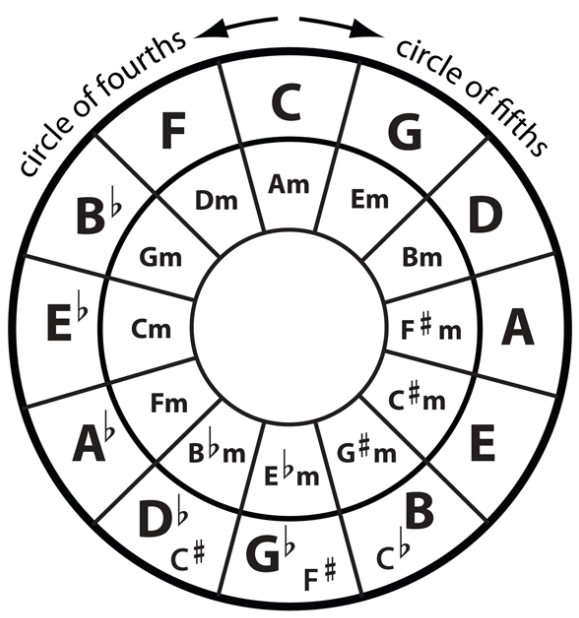
If you’re already familiar with the interval cycle of fourths in music, then relating to diatessaron progressions won’t be difficult.
Tritone Progression
Division of the octave into two equal parts yields the tritone progression.
The octave in its totality contains twelve pitch classes. Therefore, the division of these twelve pitch classes into two equal parts can be mathematically given as:
12 pitch classes / 2 parts = 6
Therefore, from one pitch class to six adjacent pitch classes in any direction will yield a tritone progression. You can only find two tritone progressions in one octave:
C-F♯
F♯-C
This melodic progression is closely related to two chromatic dissonant intervals:
Augmented fourths
Diminished fifths
There was a time in music when these intervals were called the devil in music because of their extreme dissonance.
Final Words
There’s much more to melodic progressions than we covered here. If you really want to learn more about melodic progressions, opt into our early bird list for the comprehensive course we’re releasing in 2016 that delves deeper into the concepts covered here by [thrive_2step id=’11346′]clicking here.[/thrive_2step]
These melodic progressions will prove helpful in the study of [thrive_2step id=’11346′]scales[/thrive_2step], [thrive_2step id=’11361′]chords[/thrive_2step] and [thrive_2step id=’11364′]chord progressions[/thrive_2step].